February 4, 2024
1 book · 12 highlights · 5 notes
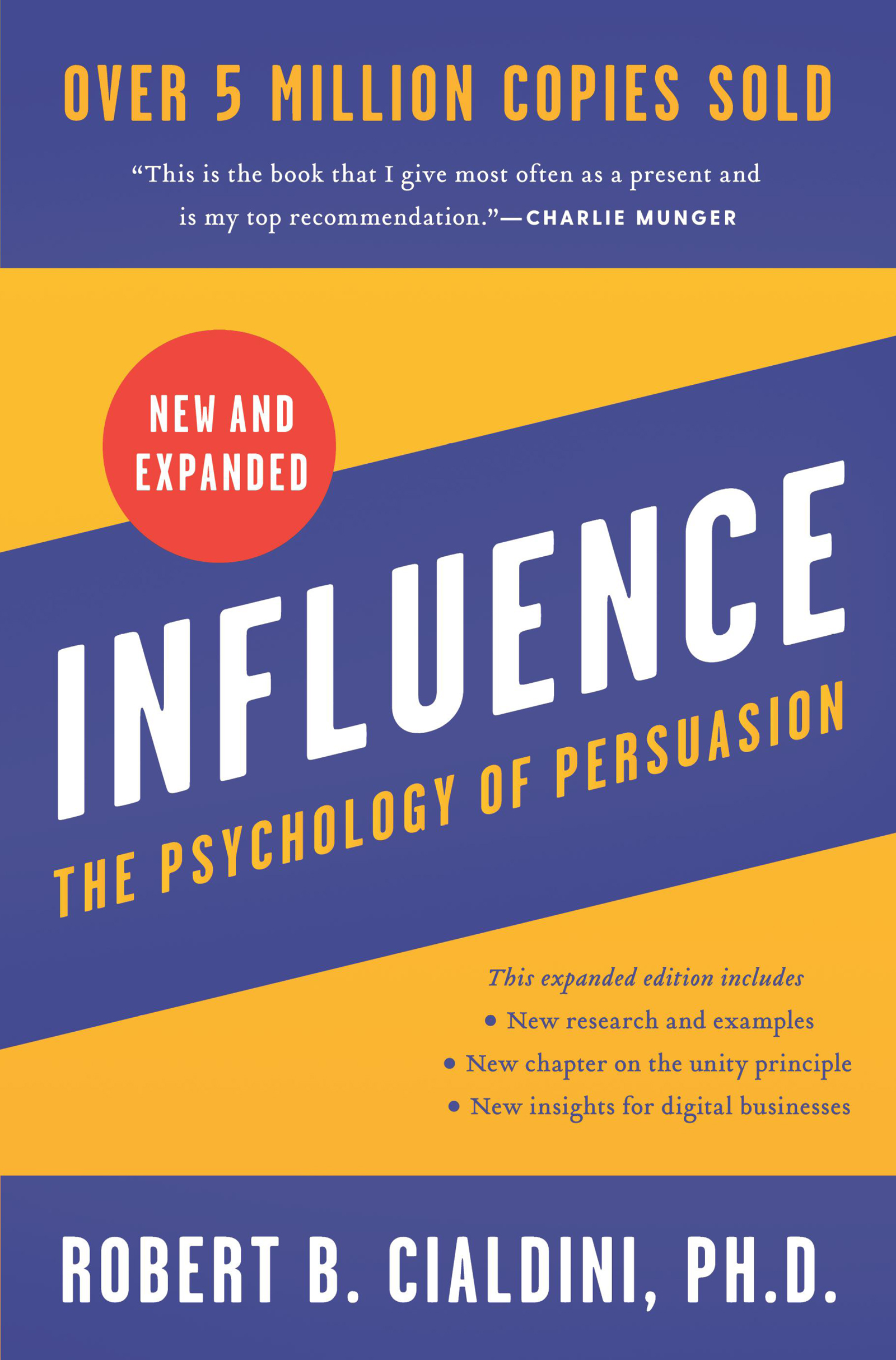
Influence
Robert B. Cialdini, PhD
“People we might ordinarily dislike—unsavory or unwelcome sales operators, disagreeable acquaintances, representatives of strange or unpopular organizations—can greatly increase the chance that we will do what they wish merely by providing us with a small initiating favor.”
1:47 AM
营销手段:送鸡蛋
✎ NOTE
“I also thought that if I were to give advice to someone who’d just received thanks for a meaningful favor, I’d warn against minimizing the favor in all-too-common language that disengages the influence of the rule of reciprocation: “No big deal.” “Don’t think a thing about it.” “I would have done it for anybody.” Instead, I’d recommend retaining that (earned) influence by saying something such as, “Listen, if our positions were ever reversed, I know you’d do the same for me.””
1:47 AM
帮助别人的时候,不要说“这是小事情”,要说“如果是你也会帮我的”
✎ NOTE
“food servers have learned that simply giving customers a candy or mint along with their bill significantly increases tips”
1:55 AM
“quid pro quo”
3:33 AM
Quid pro quo is used in this document to refer to the expectation of political contributors to receive something in return for their financial support, such as favorable legislation or government contracts. The author is suggesting that skeptics who doubt the existence of this practice could find direct evidence in the admission of businessman Roger Tamraz during congressional hearings on campaign-finance reform. Quid pro quo is commonly used in legal and political contexts to describe a transaction or exchange in which one party provides something of value to another in exchange for something else. quid pro quo (noun): something given or received in exchange for something else; a trade-off. 🔄💰
✎ NOTE
“the free sample”
3:56 AM
“Receiving the gift made recipients 42 percent more likely to make a purchase.”
3:56 AM
面包店、超市让人试吃
✎ NOTE
“The BUG consists of a collection of Amway products—bottles of furniture polish, detergent, or shampoo, spray containers of deodorizers, insect killers, or window cleaners—carried to a customer’s home in a specially designed tray or just a polyethylene bag. The confidential *Amway Career Manual* then instructs the salesperson to leave the BUG with the customer “for 24, 48, or 72 hours, at no cost or obligation to her. Just tell her you would like her to try the products. . . . That’s an offer no one can refuse.” At the end of the trial period, the Amway representative is to return and pick up orders for the products the customer wishes to purchase.”
4:03 AM
安利的营销策略
✎ NOTE
“Despite the impressive force the rule of reciprocation commands, there is a set of conditions that magnifies that force even more: when the first gift is customized, and thereby personalized, to the recipient’s current needs or preferences”
4:07 AM
“Besides customizing a gift to a recipient’s preferences, customizing it to the recipient’s current needs can also supercharge the gift’s impact.”
4:08 AM
“I’m convinced that it is the unique customizability of a *reaction* to a mistake that allows it to be experienced as a personalized gift or service”
5:02 AM
“problem-free may not feel as good to people as problem-freed”
5:02 AM
“**Author’s note:** In 2011, to celebrate its fortieth anniversary, Starbucks offered free online vouchers for a gift card. In an effort to heighten feelings of obligation associated with the gift, any customer accepting the voucher had to explicitly *thank* the company on social media. For an extended discussion of how reciprocity works on social media, see https://vimeo.com/137374366.”
10:28 AM