October 13, 2024
1 book · 16 highlights · 0 notes
The Uncertainty Solution: How to Invest With Confidence in the Face of the Unknown
John M. Jennings
“”
2:42 AM
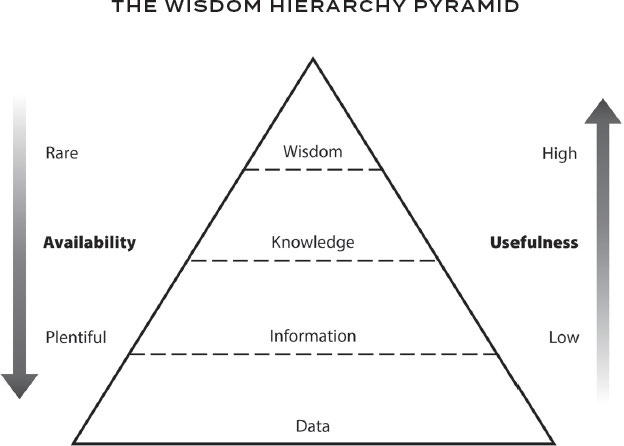
“Then he ranks them in order of usefulness and availability: wisdom is rare and most useful, while data is plentiful and not terribly helpful. ”
2:42 AM
“My pursuit of investment wisdom meant scaling the Wisdom Hierarchy Pyramid. I began by limiting my financial information and news consumption to just fifteen minutes a day. It felt great to turn off all that noise—like coming up for air after being underwater. Instead of my previously frenetic information intake, I read books—stacks and stacks of them—about investing and other relevant areas like mathematics, statistics, physics, economics, complex adaptive systems, and psychology. I supplemented the books with academic research on investing, uncertainty, brain physiology, behavioral biases, and evolutionary psychology. The common thread was to step back and try to understand how humans interact with each other in financial markets.”
2:42 AM
“Never attribute malice to that which can be adequately explained by stupidity (or carelessness, disorganization, forgetfulness, etc.).”
2:42 AM
“An example of an investment mental model is Warren Buffett’s simple and straightforward advice that successful investing requires being “fearful when others are greedy, and greedy when others are fearful.”² This is a model to apply when you feel investment FOMO (fear of missing out) when the stock market is soaring and investors are euphoric. It also reminds you that the best time to invest is when the market is down, and everyone is panicking.”
2:42 AM
“with randomly distributed”
2:42 AM
“OUR MINDS ARE SUPERBLY ATTUNED TO FINDING PATTERNS. AND WHEN WE CAN’T DETECT A PATTERN, WE GET ANTSY.”
2:42 AM
“When the stock market becomes volatile, we can feel the same way we would if a saber-toothed tiger were chasing us, even though we’re in no physical danger.”
2:43 AM
“Our aversion to uncertainty creates a need for immediate answers”
2:43 AM
“Harvard economist Richard Zeckhauser thinks of knowledge as falling in three categories: the known, unknown, and unknowable.⁷”
2:43 AM
“Therapists suggest that when people experience uncomfortable feelings— anxiety, worry, frustration, or anger—they should do . . . nothing. By learning to sit in the discomfort of your emotions, over time you gain peace and equanimity and the skills to tolerate them.”
2:43 AM
“Face, Accept, Float, Let Time Pass.”
2:43 AM
“Not only is learning to sit in discomfort helpful in our daily lives, it’s also essential to good investment behavior. From an investment perspective, we should all adopt the mantra “when in doubt, do nothing.” Warren Buffett agrees with this notion, having said, “Much success can be attributed to inactivity. Most investors cannot resist the temptation to constantly buy and sell.””
2:43 AM
“When you feel compelled to act on your portfolio, go for a walk. Read a good book. Start a home project. Try not to look at your portfolio. I know that the more I look at my portfolio, the more I’m apt to tinker. Tinkering seldom works out well.”
2:43 AM
“And when you focus only on what you can control and don’t fixate on what you can’t, you spare yourself a lot of stress.”
2:43 AM
“OUR BRAINS WANT EXPLANATIONS, AND WE ARE PRONE TO SEE CAUSATION WHERE IT DOESN’T EXIST.”
2:43 AM